
Defect Standards & GMP Consulting Tailored for Pharmaceutical and Biotech.
We eliminate uncertainty by providing two core services essential for high-stakes life science production:
Precision-Mimicking Defective Reference Standard and Expert GMP Qualification & Training Services.-
With over 25 years of accumulated expertise within Anemocyte's legacy, AMClarity is your strategic partner in establishing robust, compliant, and defensible visual inspection processes.

Anemocyte is a proud member of
Key services
Custom Defective Reference Sets
Production line and its potential contamination sources designed to challenge and qualify both manual and automated visual inspection systems.
GMP Inspection Consulting
Hands-on support, qualification protocols, and comprehensive training to elevate your team’s expertise and ensure strict regulatory adherence.
We don’t just manufacture defects;
we replicate your specific risks.
Every Reference Set begins with a deep-dive Risk Analysis of your production line, drug product, matrix formulation (appearance, viscosity, general characteristics), raw materials and potential contamination sources.
-
Engineered from the Root Cause up
By analyzing your process flow, we create "Mimics" that represent actual challenges.
-
Data-Driven Defect Creation
Transforming Risk Assessment data into physical, representative standards.
-
Defect Kits in Record Time
Receive your defect kits with a competitive delivery time.

Advanced Therapy Medicinal Products (ATMPs)

Biologics (Proteins, Peptides)

Nucleic Acid Therapies (DNA, RNA/mRNA)

Traditional Small Molecule Drugs
Defect standard set
A Defect Standard Set (also known as Defect Library Set or Test Set) is a pre-defined and verified collection of product units specifically designed to include both defective units and defect-free units. A Defect Standard Set is used to establish Defect Kits as references to train, qualify, and challenge the effectiveness of manual / automated visual inspection.
We can manage the following primary packaging and format:

Syringes

Ampoules

Vials

Cartridges

Bags
Defect classification
Defects are classified based on their impact on patient safety and product integrity.
Critical defects
Jeopardize human health or contravene legal requirements. Indicate inadequate sterility.
Major defects
Severely impair integrity and lead to a loss of performance of the product.
Minor defects
Represent a general lowering of quality but do not limit function.
The science behind visual inspection Clarity.
Manual Visual Inspection remains the gold standard to guarantee product compliance.
Despite the rise of automated systems, the human eye — supported by rigorous training and standardized protocols — provides an unparalleled level of adaptability for detecting extrinsic, intrinsic, and inherent particles. It is a fundamental commitment to patient safety and zero-defect quality culture.
Manual Visual Inspection remains the gold standard to guarantee product compliance.
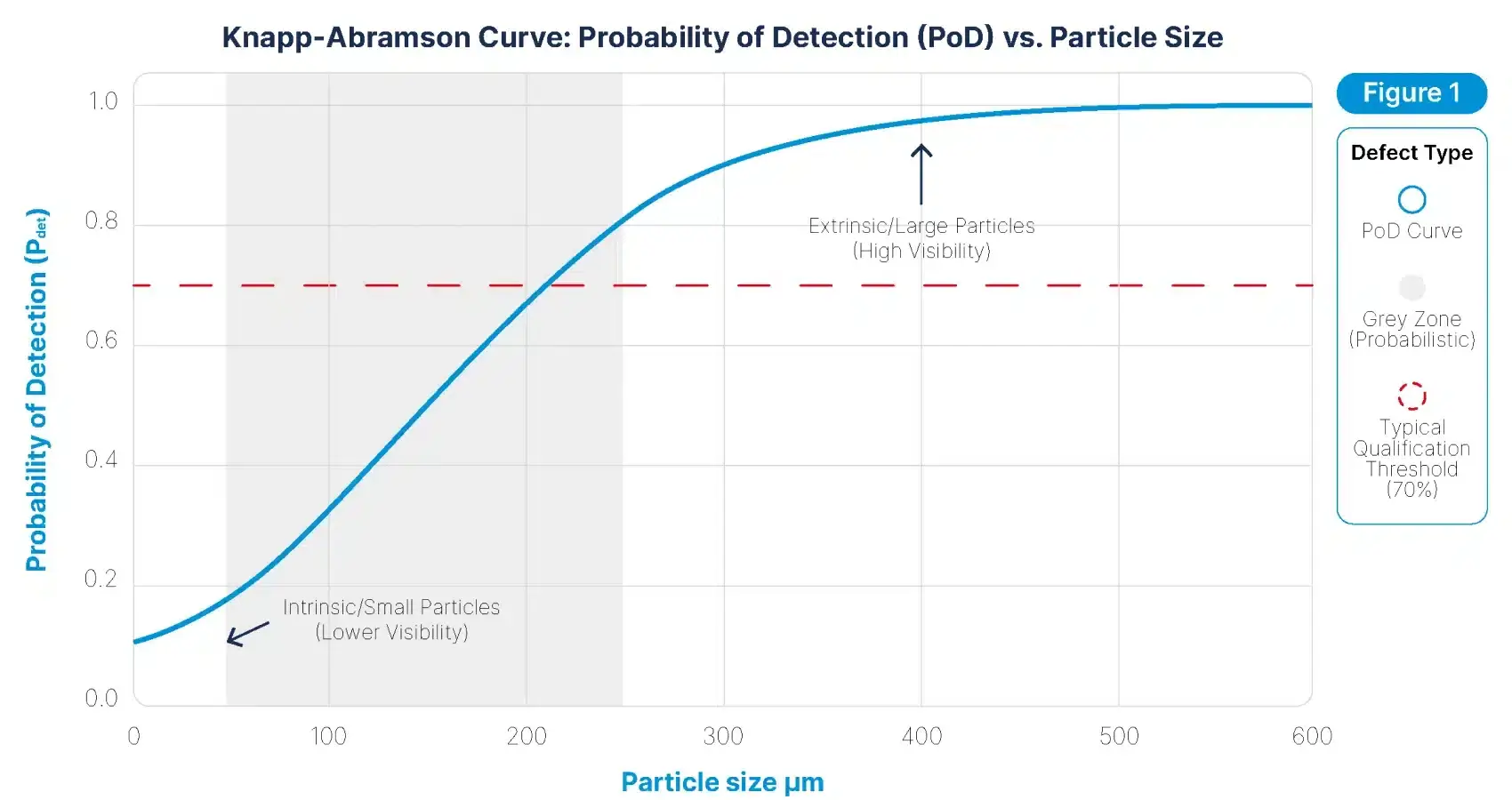
Visual inspection outcomes are based on a Probability of Detection (PoD). MVI does not guarantee 100% detection of every single particles.
Large particles (>500 µm) fall in the Reject Zone — reliably detected. Very small particles fall in the Accept Zone — below the resolution limit of the human eye. In between lies the Grey Zone: a probabilistic region where detection varies drastically based on lighting, contrast, and operator fatigue.
A well-engineered Defect Standard Set must cover all three zones to qualify an inspection system with confidence.
Engineered from the root cause up.
Every Reference Set begins with a deep-dive Risk Analysis of your production line, drug product, matrix formulation, raw materials and potential contamination sources.
By analyzing your process flow and material constraints, we create “Mimics” — physical defect standards that represent the actual challenges your inspection system will face.
Defect classification is obtained by a Risk Assessment based on an FMEA approach, ensuring every defect type and size range is relevant to your specific product and packaging.
Ready to guarantee your
product quality?
Connect with AMClarity today to build a visual inspection strategy that is compliant, efficient, and scientifically sound.
Fill the form or send a request to AMClarity@anemocyte.com
BONUS: Upon submitting this form, you will gain immediate, exclusive access to the complete data and technical results of our real-world validation study.